At long last, Portland artists are having their moment on the Jewish art world’s largest stage.
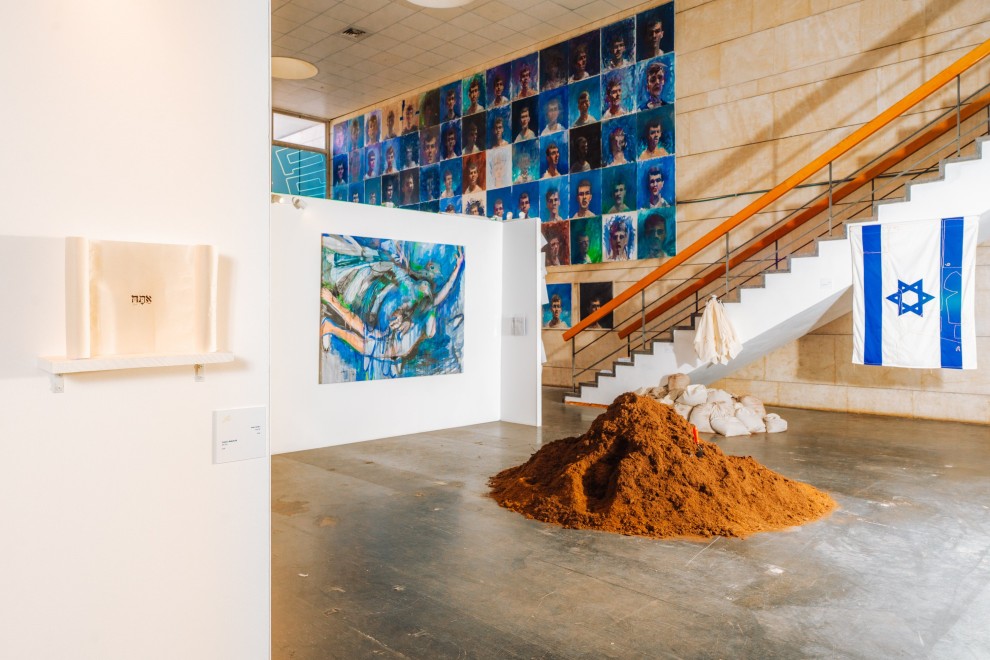
“The One Who Dwells in This House,” curated by Art/Lab Executive Director Shoshana Gugenheim Kedem and Ahuva Zaslavsky, opened at the 2026 Jerusalem Biennale on Sept. 24 and will remain open through Nov. 12. The exhibition includes work from Art/Lab alums Justin Jude Carroll, Brontë Grimm, Shir Grisanti, Jennifer Gwirtz, Daniela Naomi Molnar, Jessica Rehfield and Ketzia Schoneberg, along with the curators, and focuses on grief – the title comes from a phrase in the Mishnah Middot referring to how mourners entered the Temple in Jerusalem.
This is the seventh edition of the Biennale, and the first to follow the Oct. 7 attacks.
“It would have been last year, but they just weren’t ready for it,” Gugenheim Kedem explained. “It was supposed to open in May; because of the war, they delayed it until now.
Art/Lab’s exhibition is one of 42, spread amongst 21 venues around Jerusalem. “The One Who Dwells in This House” is set up on Hebrew University’s Givat Ram campus, in the former quarters of the National Library of Israel, near the famous “Isaiah’s Vision of Eternal Peace” stained-glass windows by Mordecai Ardon, z”l. While many curators shipped their artists’ works to Jerusalem, Gugenheim Kedem, who has previously lived in Israel and curated an exhibition in the 2015 edition of the Biennale, flew to Israel with the artwork herself.
“I wanted to be there on the ground,” she said. “It was really important for me to be there and it’s home for me. So, I took it as an opportunity to go home.”
Some of the work came in different ways than anticipated. Gwirtz, a choreographer, had planned to stage live performances of her work at the exhibition, but a scheduling conflict prevented her from making it to the rescheduled fall opening.
“I think they really did want this piece, and I had the sense that talking to Shoshana that they wanted whatever I had to offer. I actually have a long history of videography, around the same length of time that I’ve been doing choreography,” Gwirtz said. “I just sat down and looked at a bunch of rehearsal footage and then I said to my two dancers, who are amazing, ‘Can we just dedicate our last rehearsals to just getting footage for this? I have some ideas.’”
Gwirtz explained that she had been concerned about the logistics of what the performance space would be like in Jerusalem – and the always-challenging logistics of traveling to Israel. Working within the confines of a video frame opened new creative avenues for her piece, which is based on “The Amen Effect” by Rabbi Sharon Brous.
“It was much more contemplative than the live piece would have been,” Gwirtz said of the finished product. “I started experimenting with animation and playing with different animation techniques, and I think the result was honestly, it was a better piece.”
The totality of the Art/Lab exhibition was moving, as Gugenheim Kedem observed. Even among the 13 other exhibitions on display at the former National Library building, Art/Lab’s stood out.
“There were 800 people who came out to the opening night, and there was a lot of emotion,” Gugenheim Kedem recalled. “There were a lot of tears. People would come in, they’d see the work, and it was so moving; some people would just stand in the doorway and cry. It was really a very overwhelming experience in a lot of ways; really beautiful, very healing for a lot of people.”
One particularly impactful piece was “Help Me Move This Mountain,” by Zaslavsky, the co-curator.
“She had a huge pile of soil and then these beautiful sacks that she had made and had people filling them with soil and either taking it home or creating this large pile of all these sacks filled with soil,” Gugenheim Kedem said. “It’s really just a mountain of grief, but it was so metaphorically representative of a burial site, a gravesite.”
Gugenheim Kedem also experienced the resilience of Israelis, both in general and in particular in the Israeli and Jewish arts communities, which have dealt with ongoing impacts of the Oct. 7 attacks and their aftermath.
“The primary thing that I heard from my Israeli colleagues, not only my Israeli colleagues from the Biennale, but artists in all genres, is the pain of really not being invited anywhere to present their work,” Gugenheim Kedem said. “Their work isn’t getting shown, their books aren’t being published, their dance performances are being canceled, their contracts, everything.”
But there was also joy. For Gugenheim-Kedem, it was the joy of recognition for the artists she works with. There were just a handful of exhibits from the diaspora, and Portland was among them.
“It was such an honor for us to be invited, for our proposal to be accepted,” she said. “There’s never been a Portland representation at the Biennale. For Portland, Portland’s Jewish community, for Portland artists, for Jewish artists, for Art/Lab, it was really a huge honor, a big win for us.”
For more information, visit artlabpdx.org/the-art-lab and jb26.org/exhibitions/the-one-who-dwells-in-this-house.
Art/Lab 2027 apps now open
Applications are now open for Art/Lab’s fifth artist fellowship cohort.
A nine-month program of collective exploration of the intersections of Judaism, contemporary culture and creative expression through text study, dialogue and artistic practice, Art/Lab’s fellowship programs welcomes visual and performing artists, written and spoken word artists, architects, chefs, film makers, farmers, cultural producers and more.
This year’s theme is “Democrisis: Jewish Resilience Across Time.”
“ Questions for study may include,” a press release about the program explains, ”What distinguishes productive disagreement from democratic disintegration? Who gets included? Who becomes the scapegoat? What does a minority owe the democracy that protects it or the majority owe the minority? What happens to a person when citizenship stops protecting them? How does dissent serve the people? What does Jewish life look like when the social contract starts to fray? Can democracy survive when we stop seeing one another as human beings?”
Participants receive a $750 stipend, a five-day artist residency in Southwest Washington, a one-to-two-day fellows retreat, opportunities to exhibit work and connection to Art/Lab’s alumni network and programming.
Applications are due Dec. 4 and available online at artlabpdx.org.
PHOTO: Yakkov Buta for Art/Lab